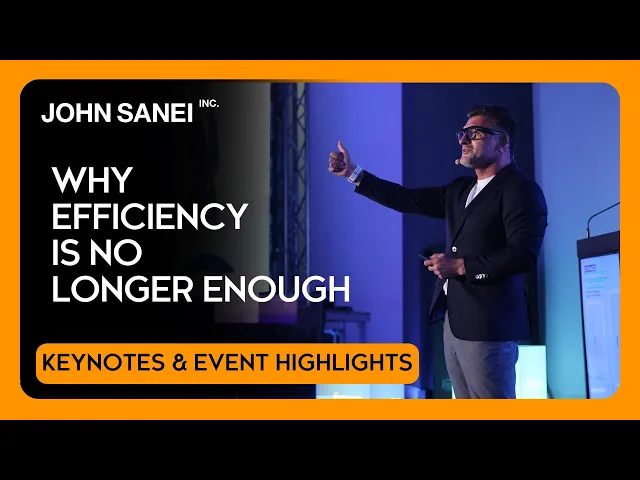

From Economies of Scale to Economies of Learning: Navigating the Shift from Complicated to Complex Worlds
Loading the Elevenlabs Text to Speech AudioNative Player...
We live in a time where predicting the future has become an exercise in futility. Economies, industries, and technologies are evolving at a pace that defies traditional forecasting.
Wars, breakthroughs in AI, and global disruptions are no longer events we can neatly plot on a timeline. Instead, the skill we need to cultivate is not prediction but preparation—preparation for constant change.
This shift requires a fundamental rethinking of how we structure our organizations, our strategies, and even our mindsets.
The difference lies in understanding the distinction between a complicated world and a complex world.
These are not just semantic differences; they represent two entirely different systems of operation, each demanding its own approach.
The Complicated World: Predictable Patterns and Efficiency
A complicated world is one we understand. It’s a world of repeating patterns, where outcomes can be anticipated, and systems can be optimized for efficiency.
This is the realm of economies of scale, where mathematics, spreadsheets, and accounting reign supreme.
In a complicated world, everything operates in straight lines, and success is measured by how well we can automate processes, reduce waste, and maximize output.
Think of a conveyor belt at an airport. It’s a marvel of efficiency—suitcases move seamlessly from one point to another with minimal human intervention.
The system works 99% of the time, and when it doesn’t, the fixes are straightforward. This is the world we’ve been trained to excel in.
We’ve become experts in conveyor belt leadership, where repetition, predictability, and efficiency are the keys to success.
But here’s the problem: the world is no longer just complicated. It’s becoming increasingly complex.
The Complex World: Unpredictability and Adaptation
A complex world is one where patterns exist but don’t repeat themselves. Outcomes are no longer guaranteed, and traditional tools like spreadsheets and linear thinking fall short.
Automation is limited in this world because there are no consistent patterns to automate. Instead of economies of scale and efficiency, the new drivers are economies of learning and robustness.
To illustrate this, let’s return to the airport analogy. While the conveyor belt represents the complicated world, the pilot flying the plane embodies the complex world.
Once the plane is in the air, the pilot has no idea what’s coming next. A storm might appear, an engine could fail, or a medical emergency might arise.
The pilot must constantly adapt, learn, and unlearn, shifting strategies on the fly. This is the essence of complexity: the ability to navigate uncertainty with agility and resilience.
The Real-World Shift: Zara vs. Shein
Let’s take this concept out of the abstract and into the real world. Consider Zara, the once-undisputed kingpin of fast fashion.
For years, Zara dominated the industry with its unparalleled efficiency. It delivers new designs to its 3,000+ stores twice a week, introduces 10,000 new designs annually, and moves products from design to store in just 10 to 15 days.
These are staggering feats of logistics and economies of scale.
Yet, over the past five years, Zara has lost a third of its market share, dropping from $19 billion to $11 billion. What happened?
Enter Shein, a company that has redefined the game. While Zara operates on economies of scale, Shein thrives on economies of learning.
Shein isn’t a traditional clothing company. It’s a powerhouse in social media, SEO, and data collection. However, it doesn’t own factories or materials.
Instead, it scrapes the internet 24/7, analyzing what clothes people are liking and sharing on social media.
Using AI, it generates 10 variations of each design in 20 colors and uploads 10,000 new styles daily. Zara’s 10,000 designs a year pale in comparison.
Here’s the kicker: Shein doesn’t produce anything until you show interest. This means its waste is a mere 2%, compared to Zara’s 20-30%.
By leveraging economies of learning, Shein can offer clothes at up to 75% cheaper than Zara while being more profitable.
It does not have logistics, warehousing, or design teams—just a relentless focus on learning from data and adapting in real-time.
The Lesson: From Efficiency to Learning
Zara’s decline isn’t a story of failure; it’s a story of paradigm shift. Zara didn’t become lazy, dumb, or poor.
It simply operated within the framework of a complicated world, excelling at what it knew best. But the world changed, and the rules of the game shifted.
The lesson is clear: We can no longer rely solely on efficiency and predictability. The future belongs to those who can embrace complexity and learn, unlearn, and relearn at the speed of change.
We must move from being conveyor belt leaders to becoming pilots—navigating uncertainty with agility, adaptability, and a willingness to embrace the unknown.
The shift from complicated to complex isn’t just a challenge; it’s an opportunity. It’s a chance to rethink how we lead, innovate, and prepare for a future that refuses to be predicted.
The question is, are you ready to take the controls?
Note: This blog post is an adaptation of the transcript from the video below, which forms part of my video series on AI.


