Is Your Business Built for a World That No Longer Exists?
Loading the Elevenlabs Text to Speech AudioNative Player...
From Prediction to Preparation
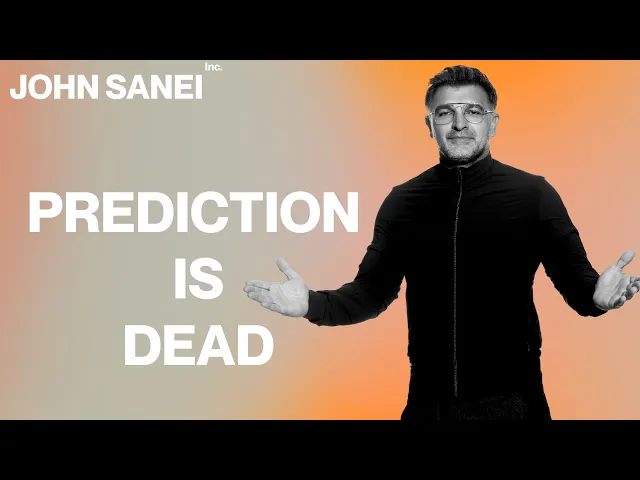
We have to become very clear about one thing: we can’t predict anything anymore. What we can do is anticipate and prepare. That’s a completely different skill set from the one we’ve been trained in.
Prediction is about certainty; anticipation and preparation are about readiness. However, the world is no longer rewarding certainty.
IQ Belonged to the Old World
This shift is the difference between IQ and AQ.
IQ requires absolute outcomes. There is a right answer, a correct prediction, and a clear destination.
AQ, the adaptability quotient, requires experimentation, learning in motion, and adjusting as you go. Understanding this difference means understanding the world we come from and the world we’re moving into.
The Complicated World We Came From
The world we came from was complicated, and the rules of that world were simple. There were patterns, and those patterns repeated. This is the world of economies of scale.
Because the future looked like the past, we became very good at pattern recognition: accounting, mathematics, logic, Excel Spreadsheets, and numbers- all of these worked because repetition made prediction possible.
In this system, everything eventually becomes automated. Automation thrives on pattern recognition and pattern repetition. This world rewards efficiency and scale.
This is what we’re still doing, and we’re doing it extremely well. But it’s becoming less and less relevant.
The Complex World
The new world arriving is not complicated, it’s complex.
In a complex world, there are some patterns, but they don’t repeat. Because they don’t repeat, logic and maths can no longer predict what’s coming next. The future is not sitting in an Excel spreadsheet.
Nothing in this system is fully automatable yet, because automation needs repetition, and repetition doesn’t exist here. This is where most people get caught out.
Economies of scale have to shift to economies of learning. And efficiency has to shift to robustness. That is a completely different way of building organisations.
From Conveyor Belts to Cockpits
Think about an airport baggage conveyor belt.
That conveyor belt is a perfect example of economies of scale. It moves in a straight line, it’s highly automated, and there are hardly any people involved. It works beautifully.
That’s how we’ve been educated. A conveyor belt system designed to deliver absolute outcomes.
Now contrast that with being the pilot of a plane.
Once you’re in the air, you have no idea what’s coming. You don’t know if there’s a storm ahead, or if an engine will fail. You don’t know what will happen.
So you over-prepare. You build four engines when one is enough, three pilots when one is enough, and eighteen operating systems when one is enough.
And because planes are designed for complexity, not complication, they are the safest way for us to travel today.
Becoming Pilots
In a complex world, the pilot operates on economies of learning. Learn, adjust, repeat.
That’s the mindset shift. We have to move from being conveyor belt operators to pilots. This requires cultivating intuition as much as technical skill.
We have to move from being operators of predictable systems to pilots navigating uncertainty in real time. And that demands a fundamentally different brain, and a completely different way of designing organisations.
FAQ
Q: What is the difference between IQ and AQ?
A: IQ is about certainty and predicting the right outcome, while AQ is about adaptability, learning, and adjusting as you go.
Q:How does the shift from complicated to complex world impact businesses?
A: In a complicated world, businesses could rely on patterns and automation. But in a complex world, they need to shift to economies of learning and robustness rather than just efficiency.
Q:Why is being a “pilot” better than being a “conveyor belt operator”?
A: Pilots have to be prepared for the unexpected and unknown, while conveyor belt operators work in a predictable, automated system. Businesses need to adopt the mindset of a pilot to succeed in a complex world.
Key Takeaways:
The world is shifting from complicated to complex, requiring a new mindset and skillset
Businesses need to focus on adaptability (AQ) rather than just certainty (IQ)
Conveyor belt operations won’t work – businesses must become more like pilots, prepared for the unknown
Economies of learning and robustness are critical in a complex world
Note: This blog post is an adaptation of the transcript from the video below.


